
November 15, 2026 · Edith Care
Sweden's health authority wants broad assessments. That takes time.
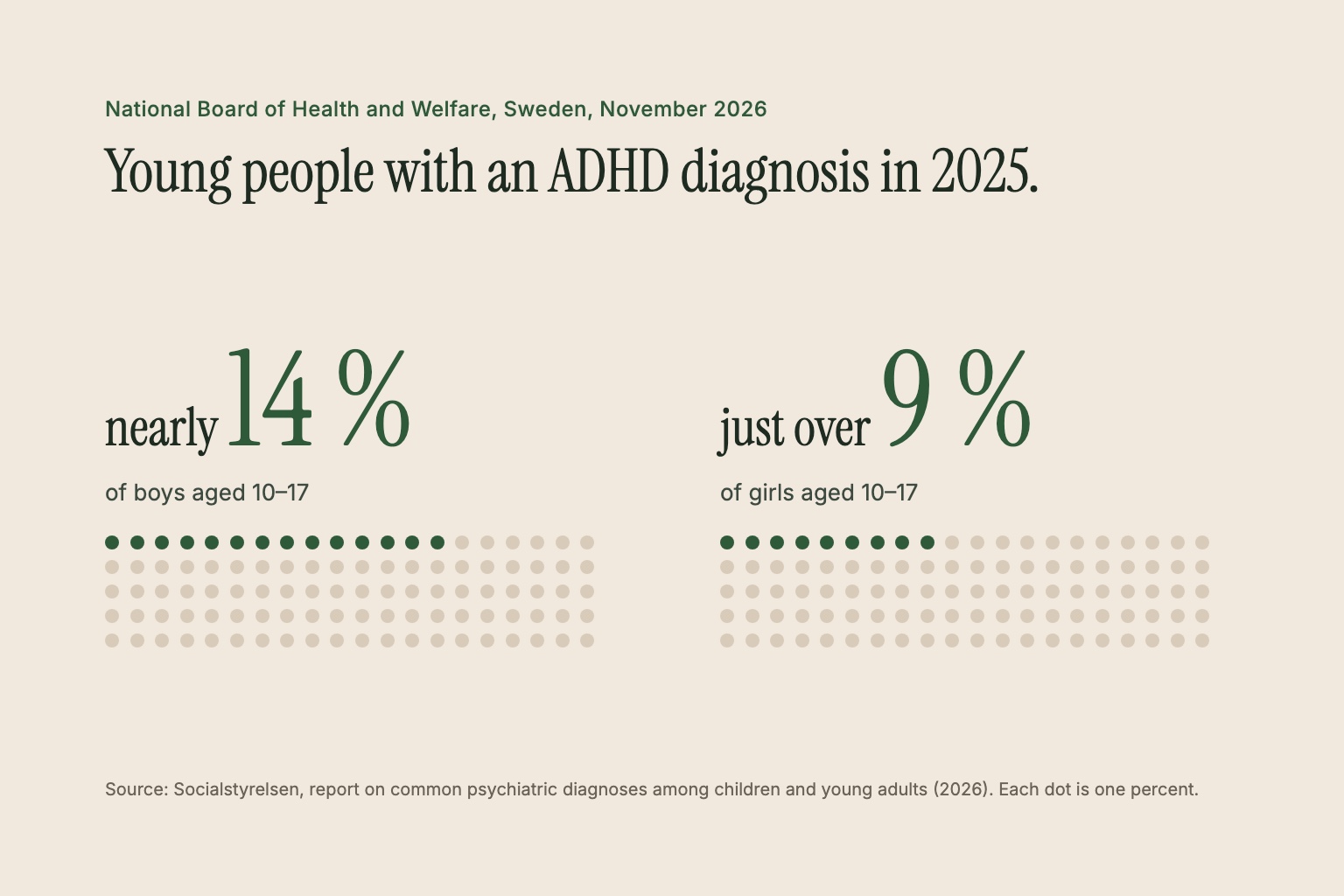
On 10 November, Sweden's National Board of Health and Welfare (Socialstyrelsen) published a report on common psychiatric diagnoses among children and young adults. For the first time, its registers show a clear fall in new diagnoses of depression and anxiety disorders. At the same time, new ADHD cases keep rising, especially among girls and young women.
The agency estimates that close to 14 percent of boys and just over 9 percent of girls aged 10 to 17 had an ADHD diagnosis in 2025. Among young adults aged 18 to 24, 5.5 percent of men and 4.5 percent of women had an autism diagnosis.
Fewer registered diagnoses do not necessarily mean young people are doing better. Some care takes place in primary care, where diagnoses are not yet recorded in the national patient register.
It looks as if mental ill health is decreasing, but it is too early to draw that conclusion.
— Lars Almroth, Director of Health Care, Socialstyrelsen (our translation)
Perhaps the most interesting part of the report is what the agency asks of healthcare. It stresses the importance of broad assessments, where other possible explanations for the symptoms and any comorbidity are considered. It also underlines that assessing possible diagnoses and comorbidity must not be missed in neuropsychiatric assessments.
Behind every diagnosis is a young person who needs the right support.
— Lars Almroth, Director of Health Care, Socialstyrelsen (our translation)
A broad assessment takes time. The psychologist needs interviews with the young person and the parents, rating scales, information from school, previous records and test results. Only when everything is side by side can you see whether the difficulties come from ADHD, autism, depression, something else or several things at once.
When demand grows, that time is exactly what risks shrinking. It is then easy for an assessment to become narrower than it should be.
That is where Edith helps. Edith gathers all the material in one place and writes the notes and a draft of the assessment. The psychologist gets more time for the conversations and for weighing up the whole picture. The assessment is always the psychologist's.
We wrote earlier about how SVT covered the same report, in the article 116,000 young people have ADHD. Psychologists need to see the whole picture.